How to Choose the Best Machine for Rice & Khichiya Papad Production
Adway Sawant · Sep 20, 2026
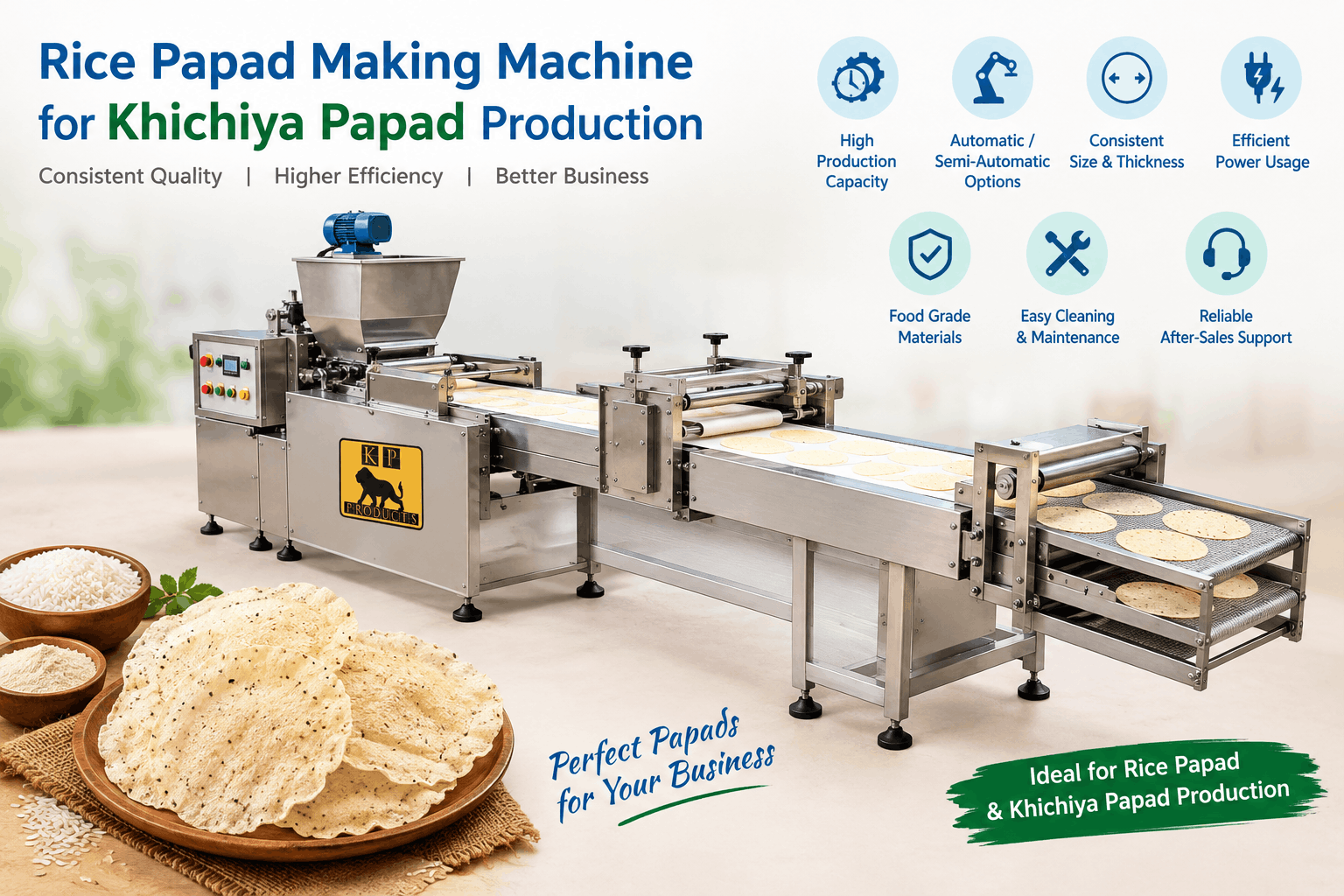
Rice and Khichiya papad are popular products in the Indian food market, and many entrepreneurs are starting or expanding papad manufacturing businesses. As production increases, manual production can become time-consuming and difficult to maintain consistently.
A suitable rice papad making machine can help improve production efficiency, maintain consistent size and thickness, and reduce repetitive manual work.
But how do you choose the right machine?
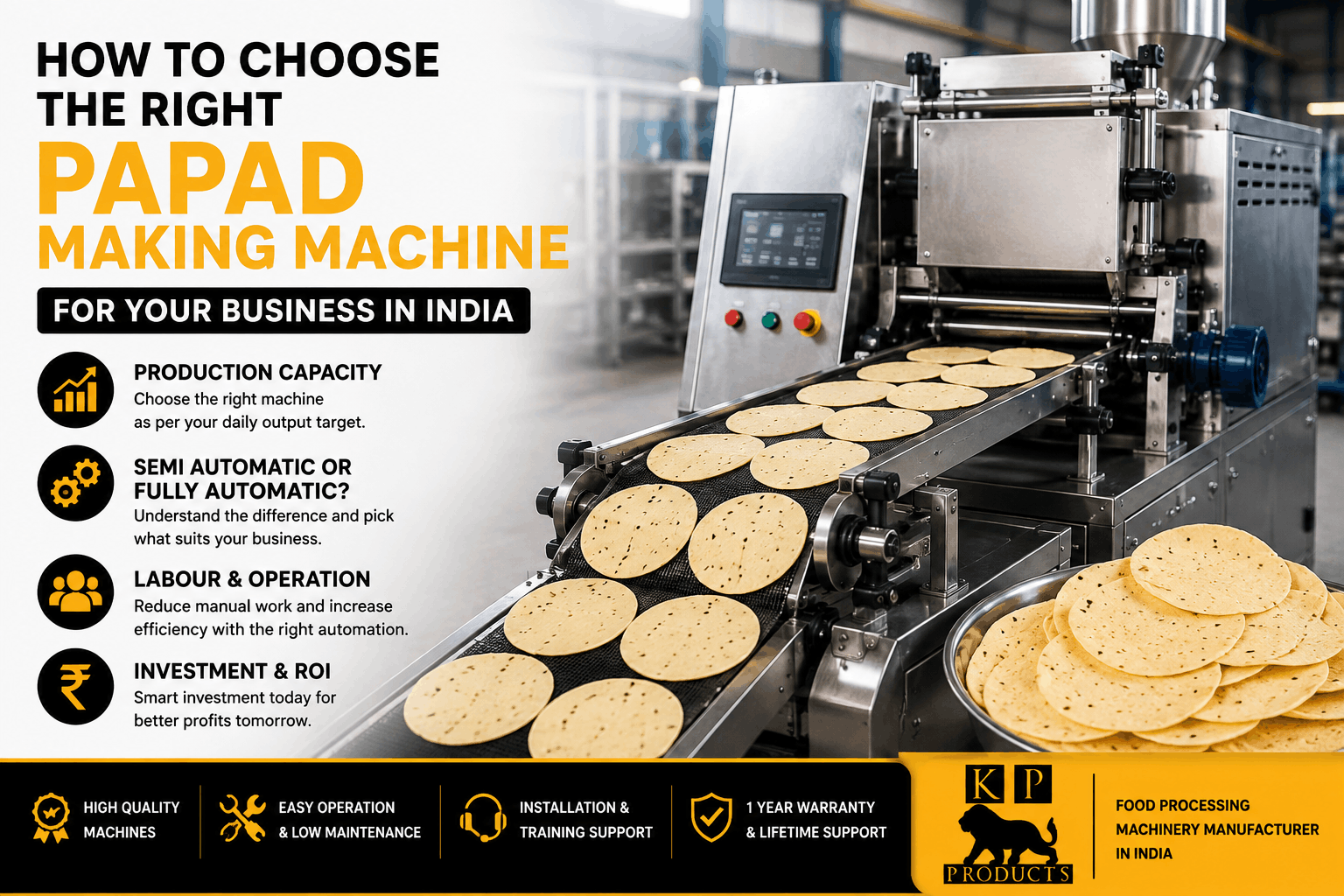
Before buying, you should consider production capacity, automation, papad size, machine specifications, power requirements, budget and after-sales support.
What Is a Rice Papad Making Machine?
A rice papad making machine is food-processing equipment used to assist in the production of rice-based papad and related products.
Depending on the machine configuration, it can help with processes such as dough feeding, forming, sheeting, thickness adjustment, cutting and shaping.
The right machine depends on your product, required capacity and production process.
6 Important Things to Check Before Buying
1. Production Capacity
First, determine how much papad you need to produce every day.
Consider:
- Daily production requirement
- Working hours
- Required hourly production
- Number of operators
- Future business expansion
Choose a machine according to your actual production requirement rather than selecting the machine with the highest capacity.
2. Automatic or Semi-Automatic Machine?
A semi-automatic papad machine can be suitable for small and growing businesses where some manual operations are acceptable.
An automatic papad machine may be suitable for businesses with higher production requirements and a need to reduce repetitive manual operations.
Your decision should depend on production volume, workforce, budget and desired level of automation.
3. Papad Size and Thickness
Different businesses manufacture different sizes and thicknesses of papad.
Before purchasing, confirm:
- Papad size
- Shape
- Thickness
- Product formulation
- Available adjustment options
If you plan to manufacture more than one type of product, ask the manufacturer whether the machine can support your requirements.
4. Power and Space Requirements
Check the machine's technical specifications before installation.
Ask about:
- Power consumption
- Voltage and phase
- Motor specifications
- Machine dimensions
- Installation requirements
Make sure your production area has sufficient space for the machine, operators and maintenance access.
5. Food-Contact Materials
Since the machine is used for food production, ask about the materials used in food-contact components.
You should also check how easily the machine can be cleaned and which parts require regular maintenance.
6. Service and Spare Parts
A papad machine is a long-term business investment. Before purchasing, ask about:
- Installation support
- Machine demonstration
- Operator training
- Spare parts
- Warranty
- Technical support
- After-sales service
Reliable support can make machine ownership easier, particularly for new entrepreneurs.
Rice Papad Machine vs Manual Production
FactorManual ProductionMachine ProductionProduction speedDepends on workersMore consistentSize consistencyCan varyMore controlledLabour requirementHigherCan reduce repetitive workProduction scalingMore difficultEasier to scaleInitial investmentLowerHigher
The right choice depends on your production volume, investment capacity and business goals.
What About Khichiya Papad?
If you are planning to manufacture Khichiya papad, confirm the machine's compatibility with your specific product before purchasing.
Discuss the following with the manufacturer:
- Dough formulation
- Required size
- Required thickness
- Production capacity
- Machine configuration
- Required attachments
This helps ensure that the machine is suitable for your actual production process.
How Much Does a Rice Papad Making Machine Cost?
There is no single price for a rice papad machine. The cost depends on factors such as:
- Machine capacity
- Automation level
- Machine configuration
- Size and specifications
- Customization
- Additional equipment
Therefore, instead of comparing machines only by price, compare their specifications, expected production, operating requirements and after-sales support.
Can You Start a Papad Business With a Government Loan or Subsidy?
Entrepreneurs may also explore government schemes such as the Prime Minister's Employment Generation Programme (PMEGP) for eligible new micro-enterprises.
Under the current PMEGP guidelines, margin-money subsidy rates are 15% to 25% for General-category applicants and 25% to 35% for Special-category applicants, depending on whether the project is located in an urban or rural area.
Eligibility, project limits, bank approval and subsidy conditions apply, so applicants should verify the current official guidelines before making financial decisions.
Questions to Ask Before Buying a Papad Machine
Before placing an order, ask the manufacturer:
- What is the production capacity?
- Can the machine produce my required type of papad?
- What sizes and thicknesses are available?
- How many operators are required?
- What is the power requirement?
- What are the machine dimensions?
- What materials are used in food-contact parts?
- Are spare parts available?
- Is installation or training provided?
- What warranty and after-sales support are available?
Why Consider KP Products?
KP Products is a food-processing machinery manufacturer based in Nashik, Maharashtra.
If you are planning to start or expand a rice papad or Khichiya papad business, you can discuss your production requirements with KP Products before selecting a machine.
The machine should be selected according to your:
Product + Production Capacity + Size + Automation + Budget + Business Goal
Contact KP Products to discuss your requirements and get suitable machine details.