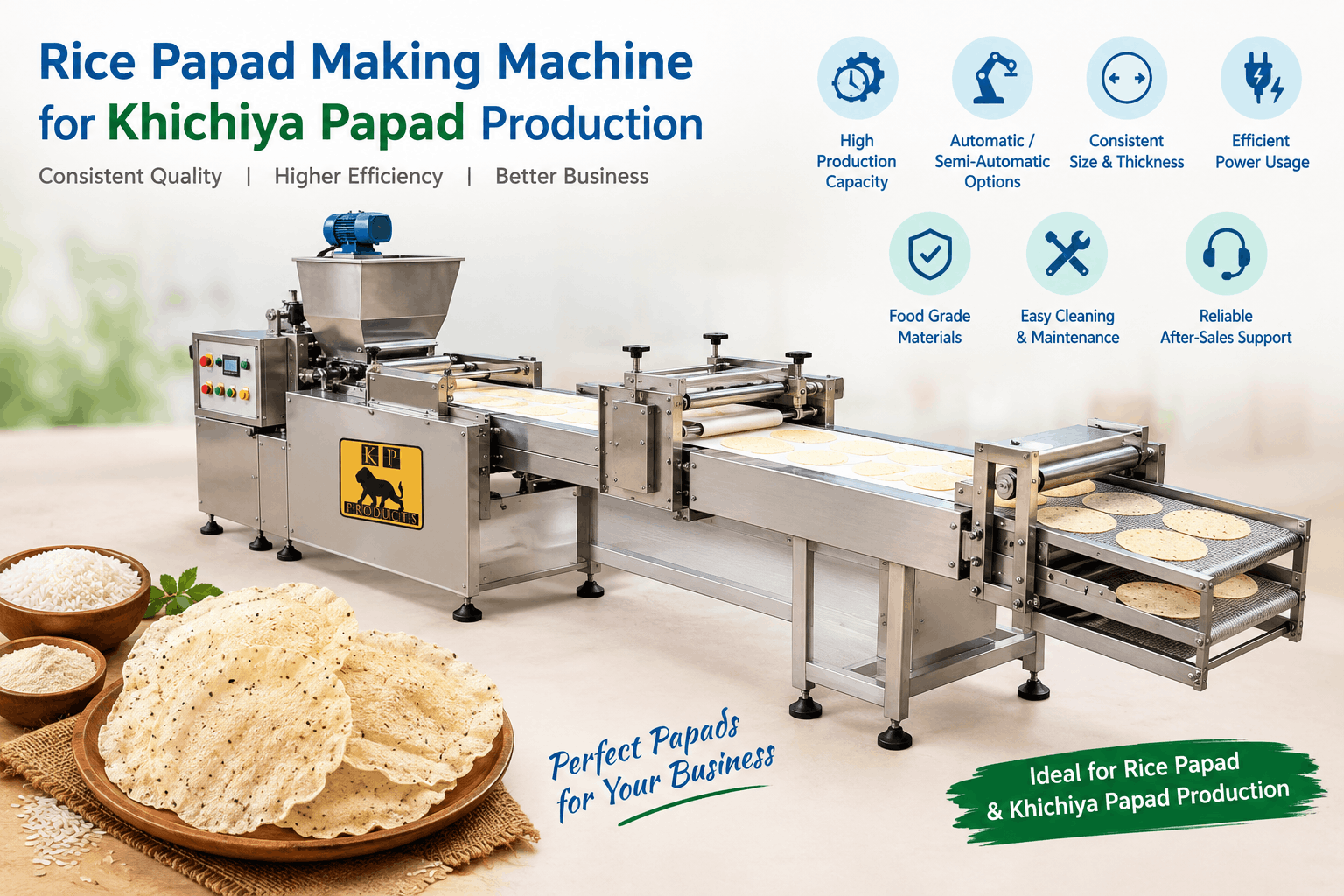
How to Calculate Papad Making Machine Production Capacity Before Buying
Adway Sawant · Oct 12, 2026

How to Calculate Papad Making Machine Production Capacity Before Buying
Choosing a papad making machine is an important decision for anyone planning to start or expand a papad manufacturing business. One of the first questions buyers ask is: How many papads can this machine produce in one hour or one day?
The answer depends on more than the machine's advertised speed. Production capacity can vary with papad size, thickness, dough consistency, feeding method, operator involvement, changeover time, stoppages and the number of acceptable papads produced.
In this guide, KP Products Nashik explains how to calculate papad making machine production capacity, estimate daily requirements and compare machine options before purchasing.
What Is Papad Making Machine Production Capacity?
Production capacity is the quantity of product a machine or production line can produce during a specified period under defined operating conditions. It may be expressed as papads per hour, papads per shift, papads per day or kilograms of product per hour.
When comparing machines, make sure that the figures use the same unit and refer to the same product and operating conditions. A machine's theoretical output is not necessarily the quantity of acceptable papads you will produce during a normal working day.
Why Should You Calculate Production Capacity Before Buying?
Calculating production capacity before purchasing a machine can help you:
-
Plan production: Estimate whether the machine can meet your daily and monthly orders.
-
Compare machines: Evaluate stated capacity using consistent units and conditions.
-
Plan labour: Understand how many operators may be required for feeding, handling and other tasks.
-
Estimate operating requirements: Plan production hours, raw materials, drying space, packaging and storage.
-
Support business growth: Choose equipment that fits current demand and a realistic future production target.
-
Avoid overestimating output: Include normal cleaning, changeovers, stoppages and product-quality losses in your planning.
Step 1: Decide Your Required Production
Before comparing machines, calculate how many papads your business needs to produce. Start with expected customer demand rather than an advertised machine capacity.
For example, suppose your planned requirement is 12,000 acceptable papads per working day. This is an illustrative business target, not a machine performance claim.
Write down your expected daily demand, working days per month, planned shifts and approximate papad size. Also consider whether you will produce one type of papad or several varieties.
Step 2: Calculate Available Production Time
Not all scheduled working time is available for making papads. Cleaning, setup, breaks, adjustments and planned maintenance may reduce the time available for production.
Formula:
Available Production Time = Scheduled Shift Time − Planned Non-Production Time
For example, assume a business schedules an eight-hour shift and plans 60 minutes for breaks, cleaning and setup.
-
Scheduled shift time = 8 hours = 480 minutes
-
Planned non-production time = 60 minutes
-
Available production time = 480 − 60 = 420 minutes
In this illustrative example, the business has 420 minutes available for production. Actual time will depend on the factory's working arrangements and machine requirements.
Step 3: Find the Actual Production Rate
The production rate tells you how many papads are produced in a given period. The most useful figure for planning is the rate achieved under conditions similar to your intended production.
Formula:
Production Rate = Total Papads Produced ÷ Actual Production Time
For example, if a trial produces 1,000 papads in 50 minutes of actual production time:
Production rate = 1,000 ÷ 50 = 20 papads per minute.
Hourly rate = 20 × 60 = 1,200 papads per hour.
These are hypothetical numbers for demonstrating the formula only. Do not use them as the stated capacity of a KP Products machine or any other machine without a relevant production trial.
Step 4: Estimate Theoretical Output
Once you have a verified production rate, you can estimate output for the time available.
Formula:
Theoretical Output = Production Rate per Hour × Available Production Hours
Using the illustrative rate of 1,200 papads per hour and 420 minutes of available time:
-
Available production time = 420 minutes ÷ 60 = 7 hours
-
Theoretical output = 1,200 × 7 = 8,400 papads
This calculation assumes the same production rate can be maintained throughout the available time. Actual accepted output may be lower because of stoppages, adjustments, variation in dough, rejected products or other production losses.
Step 5: Calculate Practical Output
Practical output is a more useful planning estimate than a theoretical maximum. Start with a measured or verified production rate, then account for additional losses that have not already been included in that rate.
Simple formula:
Estimated Good Output = Theoretical Output × Expected Operating Factor
Suppose a hypothetical process has a theoretical output of 8,400 papads and a planning factor of 90%, or 0.90.
Estimated good output = 8,400 × 0.90 = 7,560 papads.
The 90% factor is an illustrative assumption, not a recommended industry standard or a claim about KP Products equipment. For a real estimate, use production records or a suitable trial.
Important: Avoid counting the same losses twice. If your measured rate already includes ordinary stoppages and rejected papads, do not apply another factor for those same losses.
Step 6: Consider Papad Size, Thickness and Dough Type
Papad production requirements can differ by product. The size, thickness, shape and characteristics of the dough may influence machine settings, feeding, forming, handling and the speed at which a consistent product can be made.
Before selecting a machine, tell the manufacturer which products you intend to produce, such as rice papad, urad papad or khichiya papad. Do not assume that a machine's stated output for one product will be identical for another.
Ask whether the machine can produce your required dimensions and thickness, what adjustments or dies are needed, and whether a sample trial can be arranged using your intended dough or recipe.
Step 7: Check the Entire Production Process
A papad making machine is only one part of the production workflow. Your final daily output may also depend on dough preparation, feeding, collection, drying, quality inspection and packaging.
For example, a forming machine may produce papads faster than your team can handle or dry them. In that case, the slower process becomes a bottleneck and limits the quantity of finished product available for sale.
Review the capacity of each major stage:
-
Dough preparation and availability
-
Machine feeding and forming
-
Collection and transfer of formed papads
-
Drying capacity and weather-related considerations where applicable
-
Quality inspection and rejection handling
-
Packaging and finished-product storage
Estimate saleable output using the stage that limits the complete process, not just the fastest machine operation.
Step 8: Calculate Daily and Monthly Capacity
After estimating practical good output per hour, calculate production over your planned working schedule.
Daily Output Formula:
Estimated Daily Output = Good Output per Hour × Effective Production Hours per Day
Monthly Output Formula:
Estimated Monthly Output = Good Output per Day × Planned Working Days per Month
For example, if a hypothetical production setup achieves 800 acceptable papads per hour for six effective production hours, estimated daily output is 4,800 papads. If it operates for 25 days, estimated monthly output is 120,000 papads.
These figures are arithmetic examples only. Replace the assumed rate and schedule with results verified for your product, machine, staff and working conditions.
Step 9: Calculate the Capacity You Actually Need
Use your daily requirement to determine the minimum good-output rate required from a machine.
Formula:
Required Good-Output Rate per Hour = Daily Target ÷ Effective Production Hours per Day
For an illustrative target of 12,000 acceptable papads in a day and six effective production hours:
Required good-output rate = 12,000 ÷ 6 = 2,000 acceptable papads per hour.
This is the required rate of acceptable output under the stated schedule, not necessarily the machine's theoretical rate. Ask the manufacturer how its quoted capacity is measured and whether it refers to total formed papads or acceptable finished product.
Step 10: Questions to Ask Before Buying a Papad Making Machine
Before purchasing a machine, ask the manufacturer these important questions:
-
What is the stated production capacity, and what unit is used?
-
Under which papad type, size, thickness and dough conditions was it measured?
-
Does the stated capacity refer to theoretical output or output observed in a production trial?
-
How much operator involvement is needed during normal operation?
-
What are the electrical and installation requirements?
-
How much time is required for cleaning, adjustments and product changeovers?
-
Can the machine handle the product varieties and dimensions I need?
-
Are different dies, attachments or adjustments required?
-
What maintenance, training, warranty and spare-parts support are available?
-
Can I observe a demonstration or test with a representative sample before purchasing?
These questions help you compare machines based on actual requirements rather than relying only on advertised figures.
Common Mistakes When Estimating Papad Machine Capacity
Avoid these common mistakes when calculating production capacity:
-
Relying only on advertised speed: Ask for the measurement method and operating conditions.
-
Ignoring downtime: Include realistic setup, cleaning and adjustment time.
-
Confusing formed output with good output: Track acceptable papads separately from damaged or rejected pieces.
-
Ignoring drying and packaging: Check whether downstream processes can handle the machine's output.
-
Comparing different products: Compare capacity using similar papad types, dimensions and conditions.
-
Assuming one shift equals eight productive hours: Subtract planned non-production time and consider normal stoppages.
-
Planning only for today's demand: Consider realistic growth, but avoid buying capacity that your business cannot use or support.
Why Discuss Your Requirements with KP Products Nashik?
KP Products Nashik manufactures food-processing machinery and can be a point of contact for businesses evaluating papad production equipment. Choosing a suitable machine begins with understanding the product, required output and production workflow.
When enquiring, share your papad type, approximate size and thickness, daily production target, available working hours and any specific production requirements. This information helps the discussion focus on relevant machine configurations and capacity questions.
Before finalising an order, confirm the specifications, expected production conditions, installation requirements and after-sales support for the particular model. Actual output should be verified for the intended application rather than assumed from a general machine category.
Frequently Asked Questions
How do I calculate papad making machine capacity per hour?
Divide the number of papads produced by the actual production time in hours. For example, 900 papads produced in 30 minutes equals an observed rate of 1,800 papads per hour. This is only an example; actual machine output depends on product and operating conditions.
How do I calculate papad production per day?
Multiply the verified good-output rate per hour by the effective production hours available per day. Account for planned downtime and avoid applying losses twice if they are already included in your measured rate.
Is advertised machine capacity the same as actual output?
Not necessarily. Advertised capacity may be measured under specific conditions. Actual output can vary with papad dimensions, dough characteristics, operator involvement, stoppages and product quality. Ask the manufacturer how the figure was established.
Does papad size affect production capacity?
It can. Size, thickness, shape and dough characteristics may influence machine settings and handling. Ask for capacity information relevant to the product you plan to manufacture.
How can I compare two papad making machines fairly?
Compare them using the same product, dimensions, quality criteria, measurement period and operating conditions. Consider labour, cleaning, changeovers, energy requirements, service support and the capacity of the complete production process.
Should I choose a machine based only on papads per hour?
No. Also consider good-output consistency, operator requirements, product compatibility, downstream drying and packaging capacity, maintenance, available space and future demand.
What information should I share when requesting a papad machine quotation?
Share the papad type, required size and thickness, target production per day, planned operating hours, available space, power availability and any product variations. Ask for written specifications and confirmation of capacity under relevant conditions.
Conclusion
Calculating papad making machine production capacity before buying helps you make a more informed investment decision. Start with customer demand, calculate effective production time, verify the production rate, estimate acceptable output and check the capacity of the complete production workflow.
Most importantly, compare machines under similar conditions and confirm that their specifications match the papad products you intend to manufacture.
Planning to buy a papad making machine? Contact KP Products Nashik to discuss your product type, production target and machine requirements before making your decision.