Automatic vs Semi-Automatic Papad Making Machine: What’s the Difference?
Adway Sawant · Sep 28, 2026
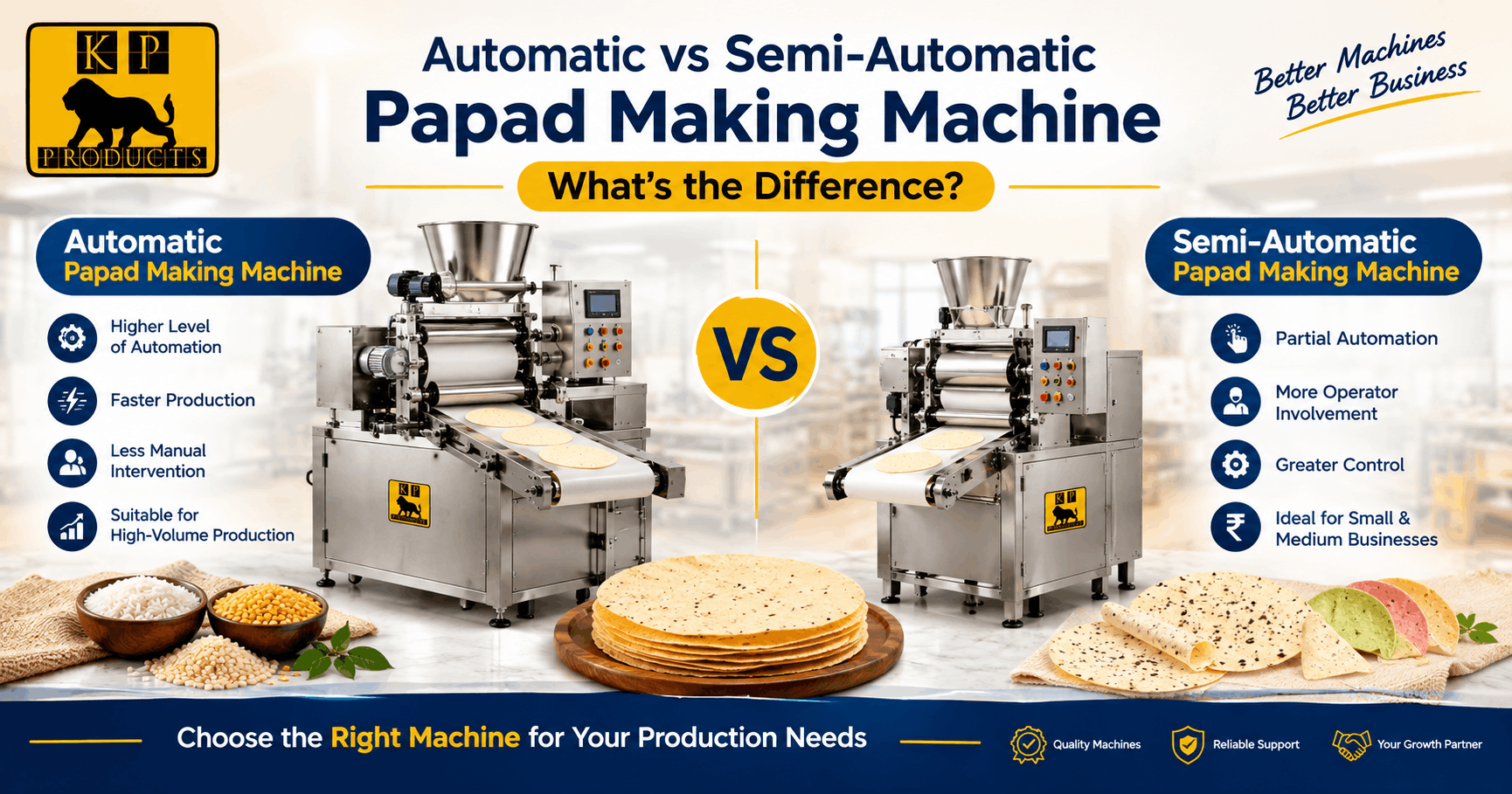
Automatic vs Semi-Automatic Papad Making Machine: What’s the Difference?
Choosing the right papad making machine is an important decision for any food processing business. The machine you select can affect production speed, labour requirements, consistency, operating convenience and overall business efficiency.
Two commonly considered options are automatic papad making machines and semi-automatic papad making machines. While both are designed to simplify papad production, they differ in the level of automation, operator involvement and production workflow.
In this guide, we explain the difference between automatic and semi-automatic papad making machines and the factors you should consider before choosing one for your business.
What Is a Semi-Automatic Papad Making Machine?
A semi-automatic papad making machine uses mechanical or powered systems to perform important parts of the papad-making process, while the operator is still involved in certain stages of production.
Depending on the machine configuration, the operator may need to handle activities such as feeding the prepared dough, positioning the dough, collecting the processed papads or managing the production flow.
Semi-automatic machines can be suitable for businesses that want to improve production compared with manual methods while maintaining greater operator control.
Advantages of a Semi-Automatic Papad Machine
- Lower level of automation compared with fully automatic systems.
- Can reduce manual effort in important production stages.
- Provides greater operator control over the production process.
- Can be suitable for small and medium-scale production requirements.
- Generally easier to integrate into a production setup where operators are already available.
- Can be considered when the business wants to increase productivity without moving immediately to a highly automated setup.
What Is an Automatic Papad Making Machine?
An automatic papad making machine is designed to automate a larger portion of the production process with less continuous manual intervention.
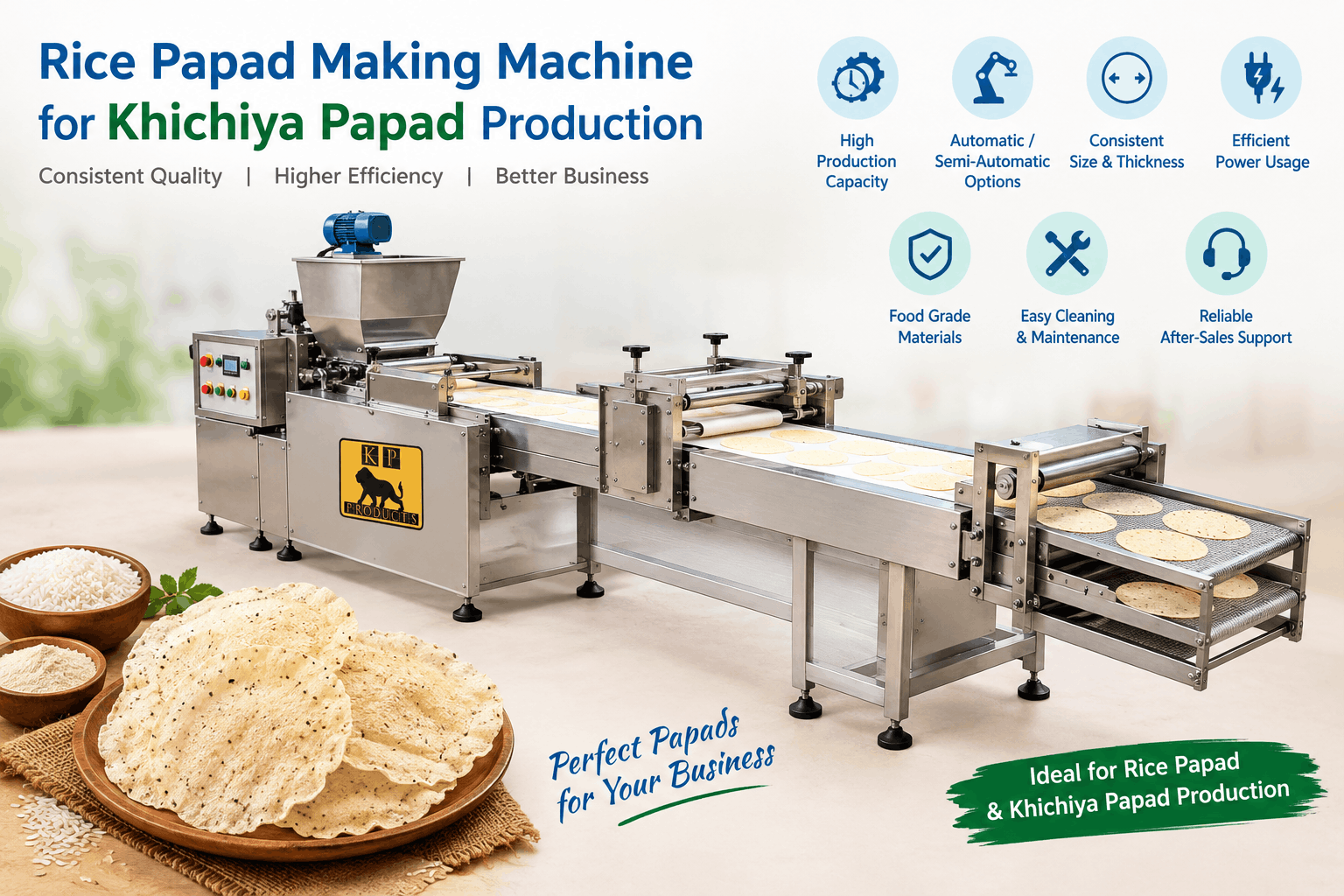
Depending on the specific machine design and configuration, automation can help manage different stages of the production process, such as dough handling, forming, rolling or pressing and output handling.
The exact level of automation varies between machines, so buyers should always check the specifications and actual production process of the particular model before making a purchase.
Advantages of an Automatic Papad Machine
- Higher level of automation.
- Can reduce the amount of continuous manual intervention.
- Can help maintain greater consistency in production when properly operated.
- Suitable for businesses looking to scale production.
- Can improve workflow efficiency by reducing repetitive manual operations.
- Can be useful for commercial and higher-volume production requirements.
Automatic vs Semi-Automatic Papad Making Machine
FactorSemi-Automatic MachineAutomatic MachineAutomation LevelPartial automationHigher level of automationOperator InvolvementMore operator involvementLess continuous manual interventionProduction WorkflowCombination of machine operation and manual handlingMore integrated production workflowLabour RequirementGenerally requires more operator involvementCan reduce repetitive manual workProduction ScaleSuitable for small to medium production requirements depending on the modelSuitable for businesses seeking higher-volume production depending on the modelOperator ControlHigher manual controlMore automated operationInitial InvestmentDepends on machine configuration and specificationsGenerally depends on the level of automation and machine configurationScalabilitySuitable for businesses starting or operating at moderate production levelsUseful when production needs to be scaled
Which Papad Making Machine Should You Choose?
There is no single machine that is suitable for every business. The right choice depends on your production requirements, available workforce, budget, available space and future growth plans.
Choose a Semi-Automatic Machine When:
- You are starting a small or medium-scale papad production business.
- You already have operators available for production activities.
- You want to reduce manual work while maintaining operator control.
- Your production volume does not require a highly automated system.
- You want a machine setup that matches your current production requirements.
Consider an Automatic Machine When:
- You have higher production requirements.
- You want to reduce repetitive manual operations.
- You are planning to expand your papad production business.
- You want a more automated production workflow.
- You want to improve production consistency and operational efficiency.
5 Important Factors to Check Before Buying a Papad Machine
1. Production Capacity
First, determine how much papad you need to produce in a day or hour. Do not select a machine only by looking at its advertised capacity. Ask the manufacturer about the actual production conditions, product size, dough characteristics and operating method used to determine the capacity.
2. Type of Papad
Different types of papad can have different dough characteristics and production requirements. Before purchasing a machine, explain the type of papad you want to manufacture and confirm whether the machine is suitable for your application.
This is particularly important when you plan to manufacture products such as rice papad, urad papad, khichiya papad or other varieties.
3. Papad Size and Shape
Consider the diameter, thickness and shape of the papad you want to produce. If you require different shapes or sizes, ask about the available dies, rollers or forming arrangements for the machine.
4. Labour Availability
Your available workforce should also be considered. A semi-automatic machine may require greater operator involvement, while a higher level of automation can reduce repetitive manual tasks.
5. Future Production Requirements
Think beyond your current production requirements. If you expect your business to grow, selecting a machine that can support your future production requirements may help you avoid replacing the equipment too soon.
Why Machine Specifications Matter
Two machines may both be described as "automatic" or "semi-automatic" but can have significantly different configurations.
Before purchasing, check important specifications such as:
- Production capacity
- Papad size range
- Papad thickness adjustment
- Machine dimensions
- Power requirements
- Material and food-contact components
- Available dies or attachments
- Operator requirements
- Installation requirements
- After-sales service and spare-parts availability
Automatic vs Semi-Automatic: A Simple Example
Imagine a business producing papads for local retailers and gradually increasing its orders.
A semi-automatic machine may provide a practical way to improve production while operators continue to manage parts of the workflow.
As order volumes increase, the business may consider a higher level of automation to reduce repetitive manual work and improve production efficiency.
This is why machine selection should be based on the business's actual production requirements rather than simply choosing the machine with the highest level of automation.
Why Choose KP Products for Papad Making Machinery?
KP Products is a food processing machinery manufacturer based in Nashik, Maharashtra, serving businesses looking for machinery solutions for papad and other food-processing applications.
When selecting a papad making machine, the machine itself is only one part of the decision. Technical guidance, machine configuration, application suitability, installation and after-sales support are also important considerations.
KP Products can help customers understand the available machine options based on their product type, production requirements and operating needs.
Frequently Asked Questions
What is the main difference between automatic and semi-automatic papad machines?
The main difference is the level of automation and operator involvement. A semi-automatic machine requires more manual handling during the production process, while an automatic machine is designed to automate a larger portion of the workflow.
Is an automatic papad making machine better than a semi-automatic machine?
The right choice depends on your production requirements. Businesses with higher production requirements may benefit from greater automation, while businesses with moderate production requirements may prefer a semi-automatic setup with greater operator control.
Which machine is suitable for a small papad manufacturing business?
A semi-automatic machine can be considered for small-scale production, depending on the required production volume, available labour and budget. The appropriate machine should be selected after evaluating the actual production requirement.
Can papad machines make different types of papad?
Machine suitability depends on the machine configuration and the characteristics of the product. If you want to manufacture different varieties such as rice papad, urad papad or khichiya papad, discuss the product specifications with the manufacturer before purchasing.
How do I choose the right papad machine capacity?
Start by calculating your required production per hour and per day. Then compare this requirement with the manufacturer's stated production capacity under the relevant operating conditions.
What should I ask a manufacturer before buying a papad machine?
Ask about production capacity, suitable papad types, size and thickness range, power requirements, machine dimensions, operator requirements, installation, warranty, spare parts and after-sales service.
Conclusion
Both automatic and semi-automatic papad making machines can play an important role in modern papad production. The right choice depends on your production volume, labour availability, budget, product requirements and future business plans.
Instead of choosing a machine only because it is labelled "automatic" or "semi-automatic", compare the actual specifications and production process with your business requirements.
If you are planning to purchase a papad making machine, speak with a machinery manufacturer and discuss your product, required production capacity and preferred papad size before making a decision.
Looking for a papad making machine? Contact KP Products, Nashik, to discuss your production requirements and available machine options.
Automatic vs Semi-Automatic Papad Making Machine: What’s the Difference?
Choosing the right papad making machine is an important decision for any food processing business. The machine you select can affect production speed, labour requirements, consistency, operating convenience and overall business efficiency.
Two commonly considered options are automatic papad making machines and semi-automatic papad making machines. While both are designed to simplify papad production, they differ in the level of automation, operator involvement and production workflow.
In this guide, we explain the difference between automatic and semi-automatic papad making machines and the factors you should consider before choosing one for your business.
What Is a Semi-Automatic Papad Making Machine?
A semi-automatic papad making machine uses mechanical or powered systems to perform important parts of the papad-making process, while the operator is still involved in certain stages of production.
Depending on the machine configuration, the operator may need to handle activities such as feeding the prepared dough, positioning the dough, collecting the processed papads or managing the production flow.
Semi-automatic machines can be suitable for businesses that want to improve production compared with manual methods while maintaining greater operator control.
Advantages of a Semi-Automatic Papad Machine
- Lower level of automation compared with fully automatic systems.
- Can reduce manual effort in important production stages.
- Provides greater operator control over the production process.
- Can be suitable for small and medium-scale production requirements.
- Generally easier to integrate into a production setup where operators are already available.
- Can be considered when the business wants to increase productivity without moving immediately to a highly automated setup.
What Is an Automatic Papad Making Machine?
An automatic papad making machine is designed to automate a larger portion of the production process with less continuous manual intervention.
Depending on the specific machine design and configuration, automation can help manage different stages of the production process, such as dough handling, forming, rolling or pressing and output handling.
The exact level of automation varies between machines, so buyers should always check the specifications and actual production process of the particular model before making a purchase.
Advantages of an Automatic Papad Machine
- Higher level of automation.
- Can reduce the amount of continuous manual intervention.
- Can help maintain greater consistency in production when properly operated.
- Suitable for businesses looking to scale production.
- Can improve workflow efficiency by reducing repetitive manual operations.
- Can be useful for commercial and higher-volume production requirements.
Automatic vs Semi-Automatic Papad Making Machine
FactorSemi-Automatic MachineAutomatic MachineAutomation LevelPartial automationHigher level of automationOperator InvolvementMore operator involvementLess continuous manual interventionProduction WorkflowCombination of machine operation and manual handlingMore integrated production workflowLabour RequirementGenerally requires more operator involvementCan reduce repetitive manual workProduction ScaleSuitable for small to medium production requirements depending on the modelSuitable for businesses seeking higher-volume production depending on the modelOperator ControlHigher manual controlMore automated operationInitial InvestmentDepends on machine configuration and specificationsGenerally depends on the level of automation and machine configurationScalabilitySuitable for businesses starting or operating at moderate production levelsUseful when production needs to be scaled
Which Papad Making Machine Should You Choose?
There is no single machine that is suitable for every business. The right choice depends on your production requirements, available workforce, budget, available space and future growth plans.
Choose a Semi-Automatic Machine When:
- You are starting a small or medium-scale papad production business.
- You already have operators available for production activities.
- You want to reduce manual work while maintaining operator control.
- Your production volume does not require a highly automated system.
- You want a machine setup that matches your current production requirements.
Consider an Automatic Machine When:
- You have higher production requirements.
- You want to reduce repetitive manual operations.
- You are planning to expand your papad production business.
- You want a more automated production workflow.
- You want to improve production consistency and operational efficiency.
5 Important Factors to Check Before Buying a Papad Machine
1. Production Capacity
First, determine how much papad you need to produce in a day or hour. Do not select a machine only by looking at its advertised capacity. Ask the manufacturer about the actual production conditions, product size, dough characteristics and operating method used to determine the capacity.
2. Type of Papad
Different types of papad can have different dough characteristics and production requirements. Before purchasing a machine, explain the type of papad you want to manufacture and confirm whether the machine is suitable for your application.
This is particularly important when you plan to manufacture products such as rice papad, urad papad, khichiya papad or other varieties.
3. Papad Size and Shape
Consider the diameter, thickness and shape of the papad you want to produce. If you require different shapes or sizes, ask about the available dies, rollers or forming arrangements for the machine.
4. Labour Availability
Your available workforce should also be considered. A semi-automatic machine may require greater operator involvement, while a higher level of automation can reduce repetitive manual tasks.
5. Future Production Requirements
Think beyond your current production requirements. If you expect your business to grow, selecting a machine that can support your future production requirements may help you avoid replacing the equipment too soon.
Why Machine Specifications Matter
Two machines may both be described as "automatic" or "semi-automatic" but can have significantly different configurations.
Before purchasing, check important specifications such as:
- Production capacity
- Papad size range
- Papad thickness adjustment
- Machine dimensions
- Power requirements
- Material and food-contact components
- Available dies or attachments
- Operator requirements
- Installation requirements
- After-sales service and spare-parts availability
Automatic vs Semi-Automatic: A Simple Example
Imagine a business producing papads for local retailers and gradually increasing its orders.
A semi-automatic machine may provide a practical way to improve production while operators continue to manage parts of the workflow.
As order volumes increase, the business may consider a higher level of automation to reduce repetitive manual work and improve production efficiency.
This is why machine selection should be based on the business's actual production requirements rather than simply choosing the machine with the highest level of automation.
Why Choose KP Products for Papad Making Machinery?
KP Products is a food processing machinery manufacturer based in Nashik, Maharashtra, serving businesses looking for machinery solutions for papad and other food-processing applications.
When selecting a papad making machine, the machine itself is only one part of the decision. Technical guidance, machine configuration, application suitability, installation and after-sales support are also important considerations.
KP Products can help customers understand the available machine options based on their product type, production requirements and operating needs.
Frequently Asked Questions
What is the main difference between automatic and semi-automatic papad machines?
The main difference is the level of automation and operator involvement. A semi-automatic machine requires more manual handling during the production process, while an automatic machine is designed to automate a larger portion of the workflow.
Is an automatic papad making machine better than a semi-automatic machine?
The right choice depends on your production requirements. Businesses with higher production requirements may benefit from greater automation, while businesses with moderate production requirements may prefer a semi-automatic setup with greater operator control.
Which machine is suitable for a small papad manufacturing business?
A semi-automatic machine can be considered for small-scale production, depending on the required production volume, available labour and budget. The appropriate machine should be selected after evaluating the actual production requirement.
Can papad machines make different types of papad?
Machine suitability depends on the machine configuration and the characteristics of the product. If you want to manufacture different varieties such as rice papad, urad papad or khichiya papad, discuss the product specifications with the manufacturer before purchasing.
How do I choose the right papad machine capacity?
Start by calculating your required production per hour and per day. Then compare this requirement with the manufacturer's stated production capacity under the relevant operating conditions.
What should I ask a manufacturer before buying a papad machine?
Ask about production capacity, suitable papad types, size and thickness range, power requirements, machine dimensions, operator requirements, installation, warranty, spare parts and after-sales service.
Conclusion
Both automatic and semi-automatic papad making machines can play an important role in modern papad production. The right choice depends on your production volume, labour availability, budget, product requirements and future business plans.
Instead of choosing a machine only because it is labelled "automatic" or "semi-automatic", compare the actual specifications and production process with your business requirements.
If you are planning to purchase a papad making machine, speak with a machinery manufacturer and discuss your product, required production capacity and preferred papad size before making a decision.
Looking for a papad making machine? Contact KP Products, Nashik, to discuss your production requirements and available machine options.